Although many crops can be grown on this tropical island with plenty of agricultural land, Barbados imports about 85% of its food. This is precarious when the economy and major trade routes are increasingly affected by sanitary crises, political conflicts and climate change. Poor diets are also a heavy burden in Barbados, where one in three adults is hypertensive and one in five diabetic.
To understand the causes of this situation and raise awareness about the dangers and solutions, I created a research project on potential and challenges of food sovereignty on the island, and made a documentary film about it to communicate my research findings to local and regional audiences.

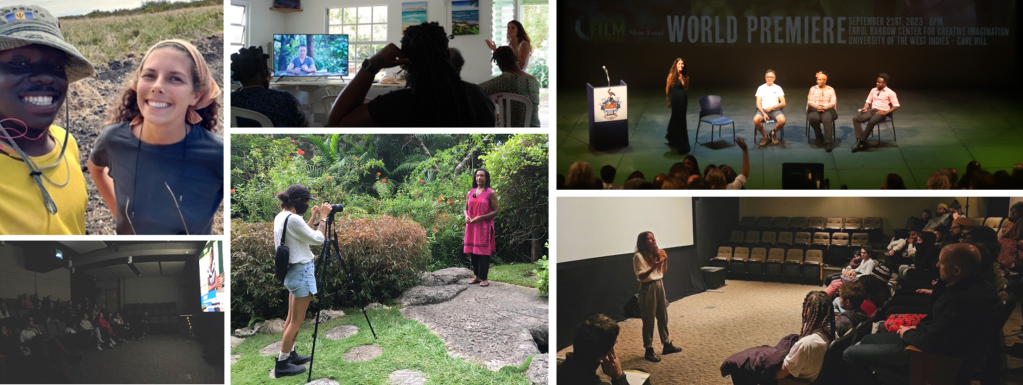
Since 2023, Food What? Looking for Food Sovereignty in Barbados has screened in Barbados, the US and Canada, in film festivals, conferences and schools. The film has received a Finalist Award in the Best Film About A Social Issue Category at the Student World Impact Film Festival, was selected at the Ceres Food Film Festival (NYC, US), and at the Green Screen Environmental Film Festival (Trinidad). The feature film is 70 minutes long, and a shorter version (40mins.) is available for wider audiences. Thanks to the organization Villes-Régions-Monde, the film is also available with French subtitles, and will soon have Spanish subtitles as well.
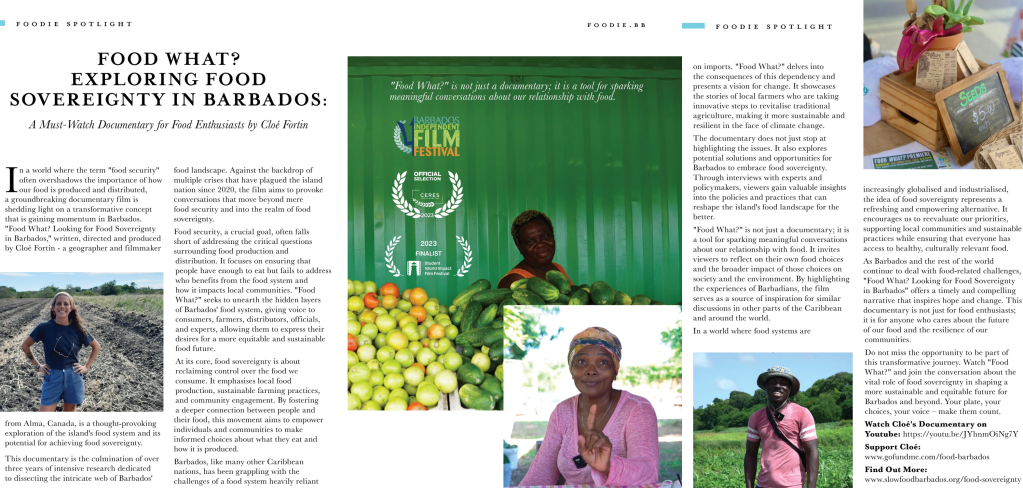
As an independent filmmaker, I funded the project myself through student grants and personal loans, and a lot of volunteer work to plan, film, edit, and distribute the film. All of the interviewees, as well as the narrator, Richard White, and the musician who created the original score, Marley Kirton, also volunteered their precious time.
While the film will be available online soon, screenings are essential to spark conversations and reach farming communities, not only in Barbados but around the Caribbean and in other regions of the world facing similar issues. Indeed, many colonized territories still suffer from the impacts of the global food system (high dependence to external markets, malnutrition, loss of traditional knowledge and lifestyles), from Africa to the South Pacific.
With the support of the Panta Rhea Foundation and a collaboration with Slow Food Barbados, more screenings will take place in 2024 in Barbados, the Caribbean and Central America, but local contacts and facilities are still needed. Please connect with me if you might be able to help! You can also help by watching and sharing the trailer, come to a screening or support my gofundme campaign and share it through your network. You can also follow me on instagram for updates!
 cocogreen